Quantum-safe networks still need trusted time. Critical networks are moving to quantum-safe encryption, and their timing must move with them. Encrypted links are where conventional PTP faces its greatest difficulty.
Governments, grid operators, banks and defence organisations are encrypting a growing share of their traffic and preparing for a future in which today’s public-key cryptography may be broken. These networks also carry precise time to base stations, substations, radars and data centres. Encryption alters how packets traverse the network, and precision timing is highly sensitive to those changes. This article examines why quantum-safe encryption is spreading, why it complicates synchronisation, and what a Finnish critical-network operator achieved when it tested precise time transfer over QKD-secured encrypted links.
1. Drivers of quantum-safe encryption
Quantum-safe encryption has moved from research topic to procurement requirement, driven by three developments.
Encrypted data is being harvested now. Adversaries can intercept and store encrypted traffic today and decrypt it once a cryptographically relevant quantum computer becomes available. Security agencies refer to this as “harvest now, decrypt later”. The attack can begin before any quantum computer exists, so any data that must remain confidential beyond that date is already at risk (CSA).
Guidance is now setting deadlines. The European Commission’s roadmap asks member states to begin the transition by the end of 2026, protect critical infrastructure by 2030 and convert as much as is practically possible by 2035. In the United States, an executive order signed in June 2026 requires quantum-safe key establishment for high-value systems by the end of 2030. From 2027, France’s ANSSI will no longer certify security products that are not quantum-safe (CSA).
Infrastructure is being deployed. Europe is building capacity in advance of the threat:
EuroQCI: All 27 member states and the European Space Agency are developing a quantum communication infrastructure to protect government institutions, data centres, hospitals and energy grids. It combines national fibre networks, 19 cross-border links and a satellite segment. The first prototype satellite, Eagle-1, is scheduled for late 2027 (European Commission).
EuroQCI in Finland: A VTT-led consortium is building a national quantum encryption network. Erillisverkot and Cinia are jointly responsible for a dedicated test network for government authorities (Erillisverkot).
The term “quantum-safe” covers two technologies. Post-quantum cryptography (PQC) replaces vulnerable algorithms with new ones. Quantum key distribution (QKD) uses the principles of physics to deliver keys over fibre. Both supply keys to the same type of encryptor, typically AES-256 on the data path. For synchronisation, the relevant point is that regardless of how a key is established, timing packets still pass through an encryptor.
2. Why encryption and synchronisation are difficult to combine
Encryption can pose significant challenges for precision time transfer, whether the keys are established through conventional, post-quantum or quantum key distribution methods. The central issue is how encryption affects packet delay, asymmetry and timestamp visibility.
PTP depends on symmetry. The Precision Time Protocol estimates the delay between two clocks by measuring it in both directions and assuming the two directions are equal. Any difference between them results in time error equal to half that difference. One microsecond of uncorrected asymmetry produces 500 ns of error, roughly a third of the 1.5 µs tolerance of a 5G TDD network.
Depending on the network architecture, encryption can violate this assumption in four ways.
Encryption introduces asymmetry. Encryption and decryption follow different processing pipelines, so delay differs by direction. At ITSF 2026, one router vendor measured approximately 94 ns of added delay on the transmit side and approximately 1 ns on the receive side in one MACsec implementation. A fixed offset of this kind can be measured and calibrated out, provided it remains fixed.
Encryption introduces jitter, which is the harder problem. Encryptors buffer, queue and batch packets, rotate keys and share processing resources with other traffic. Delay therefore varies from packet to packet and with network load. Variable delay cannot be calibrated away and must instead be filtered, and the greater the variation, the longer and more demanding the filtering. EANTC’s 2026 interoperability tests describe this directly: MACsec introduces “latency variations and asymmetry across timestamping points”, while PTP assumes a constant link delay (EANTC).
Timestamps become unreadable. Once a PTP packet is encrypted, intermediate nodes see only ciphertext. A boundary clock or transparent clock cannot read or correct a timestamp it cannot see, so the on-path support that conventional PTP relies on is lost inside an encrypted tunnel. Even at the receiving end, a node must decrypt a packet before it can identify it as a PTP packet. Calnex observed at ITSF 2026 that this may force a receiver to timestamp all incoming traffic.
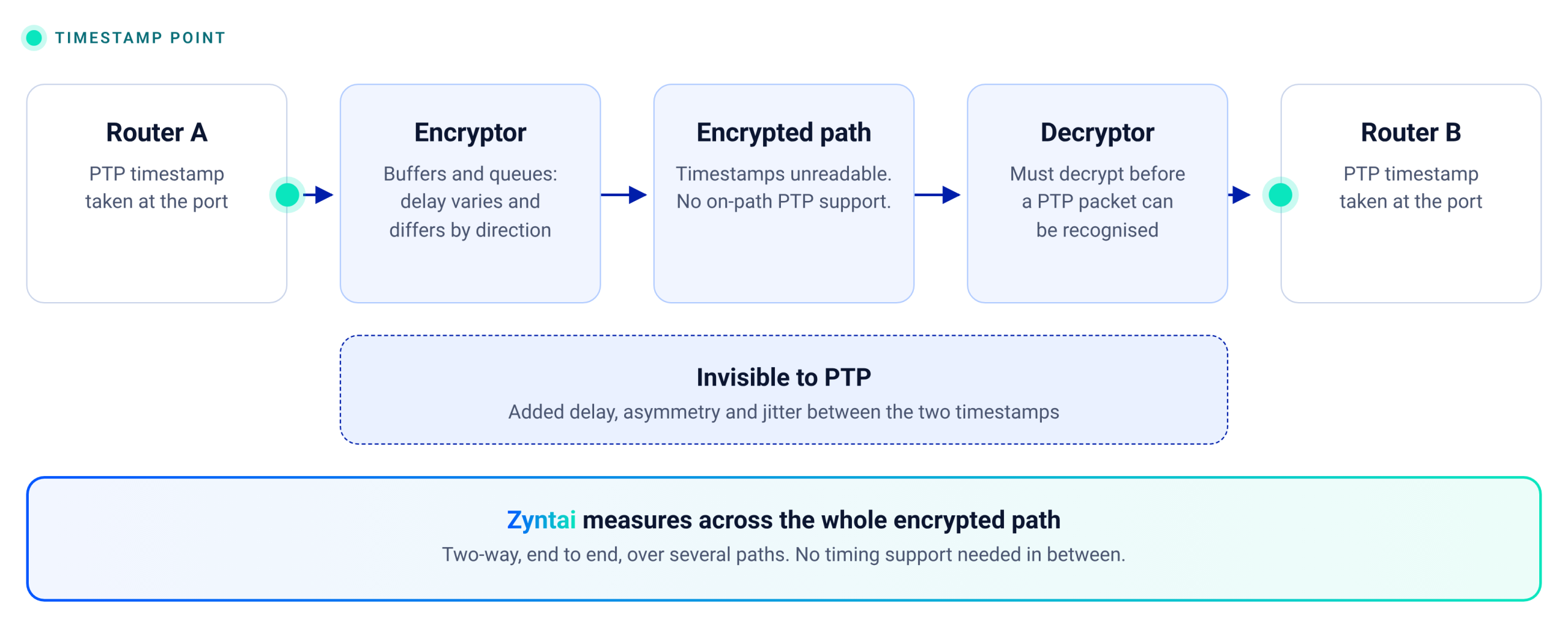
Encryption sits outside the timing chain. In a typical network, the PTP timestamp is taken at the router or switch port, and encryption takes place afterwards, either in a separate encryptor or in a stage the timing function cannot access. Any delay the encryptor adds, whether fixed or variable, is invisible to PTP. Integrated solutions exist in which the vendor places timestamping and encryption on the same chip, so the timestamp is taken after encryption. At ITSF 2026, one vendor demonstrated this with both functions on the router’s PHY, achieving a constant time error of 20 ns over two hops. However, such integration remains the exception: only two vendors supported PTP over MACsec in EANTC’s 2026 tests. Few standalone encryptors, including IPsec gateways, layer 1 and layer 2 bulk encryptors, QKD-keyed encryptors and military crypto devices, offer any built-in PTP support.
PTP can measure only the delay between its two timestamps. Any delay introduced by encryption between those points is hidden from it.
Whether encryption stops delay attacks depends on the layer. Researchers at TU Wien showed that when PTP is encrypted packet by packet, for example with MACsec at layer 2 or IPsec at layer 3, the timing packets can still be recognised by their size, rate and direction, and then selectively delayed to pull a clock off time. Packet encryption protects the content of a packet, but not the time at which it arrives (Annessi et al.). Layer 1 encryption, as used in the Erillisverkot pilot, changes the picture. The entire optical signal is encrypted, so an observer sees a continuous encrypted bit stream with no visible packets to single out.
QKD networks raise further architectural considerations. Because individual QKD links are limited in distance, larger networks often rely on trusted nodes for key distribution. Depending on the encryption architecture, traffic may also cross multiple encryption domains, each of which may add delay characteristics that must be accounted for in precision time transfer.
An alternative approach. The practical solution is not to make every encryptor timing-aware. Instead, the encrypted network is treated as a black box and measured across. Zyntai exchanges timestamps in both directions, continuously and over multiple paths where the network provides them, and filters delay variation without requiring PTP support in the intermediate nodes. Two-way measurement alone cannot reveal a fixed asymmetry, so each link is calibrated once against a reference: GNSS at the time of calibration, a portable reference clock, or reports from GNSS-equipped equipment already in the network. After calibration, Zyntai continuously monitors path delay characteristics and timing consistency. Changes in round-trip delay, or disagreement between independent timing paths, can indicate that a path requires reassessment. Changes in one-way delay asymmetry, however, cannot always be detected from two-way measurements alone. Calibration, independent references and path diversity are therefore essential elements of a resilient timing architecture. Time is delivered as standard PTP at the edge, where applications require it.
Protection against delay attacks.Zyntai secures its own timing exchanges through encryption and authentication, which helps prevent unauthorised modification of timing messages. Inside a layer 1 encrypted tunnel, its timing packets are also hidden in the encrypted bit stream and cannot be singled out. What remains is a cruder attack: delaying the whole signal in one direction, for example at a point where the fibre can be accessed. Such a delay affects all traffic on the link and changes the measured round-trip delay. Where the network offers several paths, the affected path also disagrees with the others and can be removed from use. On a single path, the change appears as a step in measured delay, and the node maintains time on its local oscillator while the change is assessed. Independent references and path diversity remain important.
For critical network operators, this is more than a synchronisation challenge. It is an architectural constraint. If precise time requires timing-aware equipment throughout the transport path, encryption upgrades may become costly and complex. The ability to maintain accurate time across existing encrypted infrastructure allows security to be modernised without redesigning the synchronisation network.
3. Field validation: time error tests
Erillisverkot and Net Insight have previously collaborated on resilient timing under real-world conditions. At Jammertest 2025 in Norway, they examined how GNSS spoofing affects time synchronisation and presented the results at ITSF 2025 (Net Insight). The next question was whether precise time could be carried over QKD-secured encrypted links. Hans Sjöstrand (Net Insight) and Simo Hallikainen presented the results of the joint pilot at ITSF 2026 in Geneva on 5 November, in the session “Precision Time Transfer over Quantum Cryptography” (ITSF 2026 programme).
Results. The pilot was conducted in two phases within Erillisverkot’s operational network. In the first phase, time was carried over a DWDM network across a 400 km submarine fibre link in the Gulf of Finland, using commercial layer 1 or layer 3 encryptors. The encryptors were keyed with a hybrid of QKD and PQC through the standard ETSI GS QKD 014 interface. Measured against an external time reference, the time error was approximately ±20 ns. In the second phase, the link was extended to more than 1,300 km, reaching the Finnish mainland, through a QKD- and PQC-encrypted layer 1 tunnel. After further tuning by the Erillisverkot team, the total time error relative to an external reference measured approximately ±10 ns over the 1,300 km path in the tested configuration. The measurements presented at ITSF cover approximately one day, but tests running over several weeks have produced the same results.
Significance. This path matches the conditions section 2 identifies as most challenging for PTP: long distance, an encrypted layer 1 tunnel and no timing support within the encryption. A time error of around 10 ns is a small fraction of the 1.5 µs budget for 5G TDD and well within the sub-microsecond accuracy required by power-grid protection and many defence applications. Meeting these requirements in a live network also depends on the end-to-end timing architecture, including redundancy and holdover, not on transfer accuracy alone.
No single pilot resolves every question for every network. Link calibration, timing behaviour during reroutes and key changes, and performance when GNSS is unavailable all depend on the topology and encryption architecture. These are precisely the questions to address for your own network.
4. Conclusion
Quantum-safe encryption is being introduced into critical networks on a fixed timetable, and timing must be introduced alongside it. Making every encryptor timing-aware is not a realistic option, given how few encryptors currently support PTP. A more practical approach is to distribute time end to end across the encrypted network, monitor timing performance continuously and verify accuracy against independent references where available. The Finnish pilot demonstrated time transfer accuracy of approximately ±10 ns over more than 1,300 km of QKD-secured encrypted fibre in an operational network.
Encryption protects what your network communicates. Trusted time ensures that it happens when it should.
Planning a quantum-safe network? Our Sync engineers can take your team through the pilot set-up and results, and assess what precise time across your own encrypted transport would require.