• Main
  • Investors
  • 5G Sync
  • Sync Partner portal
  • Partners
  • Support
  • Careers
  • Shopping Cart Shopping Cart
    0Shopping Cart
Net Insight
  • INDUSTRIES
        • All Industries
        • Media Service Provider
        • Broadcasters
        • Production Companies
        • Event organizers
        • Synchronization
  • SOLUTIONS
    • Production Solutions
      • For Media Service Provider
      • For Broadcaster
      • For Production Companies
    • Contribution Solutions
      • For Media Service Provider
      • For Broadcaster
      • For Production
    • Distribution Solutions
      • For Media Service Provider
      • For Broadcaster
    • Synchronization Solution
  • NETWORKS
      • Managed Network Solutions
          • Media Service Provider
          • ProductionRemote and distributed production over managed IP networks as-a-service
          • Contribution Contribution over managed IP networks as-a-service
          • DistributionPrimary distribution over managed IP networks as-a-service
          • Broadcaster
          • Production Remote and distributed production over managed IP networks
          • ContributionContribution over managed IP networks
          • DistributionPrimary distribution over managed IP networks
          • Production Company
          • ProductionRemote and distributed production over managed IP networks
          • ContributionContribution over managed IP networks
      • Cloud & Internet Solutions
          • Media Service Provider
          • ProductionRemote and distributed production over cloud networks as-a-service
          • ContributionContribution over cloud networks as-a-service
          • DistributionDistribution over cloud networks as-a-service
          • Broadcaster
          • ProductionRemote and distributed production over cloud networks
          • ContributionContribution over cloud networks
          • DistributionDistribution over cloud networks
          • Production Company
          • ProductionRemote and distributed production over cloud networks
          • ContributionContribution over cloud networks
  • PRODUCTS
        • Products
        • ProductsFind datasheet to our products here
        • Features
        • IP AppliancesTrust boundary IP Appliances
  • RESOURCES
        • Blogs
        • Case Studies
        • Data Sheets
        • White Papers
        • Videos
  • Investors
  • Company
        • About Us
        • Contact Us
        • Board & Management
        • Awards
        • Memberships
        • Events
        • News & Press releases
        • Resellers
        • Tech Partners
        • Investors
        • Careers
        • Partner Portal
        • Support
  • Click to open the search input field Click to open the search input field Search
  • Menu Menu
  • Main
  • Investors
  • 5G Sync
  • Sync Partner portal
  • Partners
  • Support
  • Careers

BLOG

Enabling Live Sports Growth and Creating New Revenue Opportunities with JPEG XS in Video Networks

The landscape of live media consumption is evolving rapidly, with viewers increasingly complementing their linear, live viewing with short-form content and on-demand video services. Amid these changes, classic tier 1 sports programming is evolving as well, with innovative camera views and gamification production styles to captivate a new generation of audience. To meet the demands of this dynamic environment, network operators and content producers are turning to advanced compression technologies to manage a greater number of media streams and new workflows such as clip generation to unlock new revenue opportunities.


More Content – More Media Paths

With an increased number of media paths and potential new revenue streams, network nodes may need reconfiguring to accommodate additional flows. Some network operators are now considering the best ways to deliver increasing channel densities whilst ensuring the right balance of other video characteristics are met.

In seeking to deliver increased channel density, many factors need to be balanced. Implicit in live production is the need to deliver content in real-time with minimal latency. Video quality benchmarks need to be met, with tier 1 productions frequently demanding that near-source quality video is preserved up to the point of consumer delivery. Rack space occupancy, CO2 consumption and channel bandwidth occupancy all become important considerations.

Preserving Source Quality

While uncompressed video transfer guarantees premium source quality, it often comes at a price. Large bandwidth availability can be costly and is rarely unlimited. And so, to optimise resources, video compression often becomes a necessity. The choice of compression technology involves considering trade-offs between picture quality, latency, and compressed bit rate.

When Compression is a Necessity

In order to achieve best usage of available bandwidth resources, video compression is often employed. But which type of compression?

Light compression systems such as JPEG 2000 have been in use for over a decade, offering low latency and near-lossless compression within bit rates of a few hundred Mbit/s for HD services.

Highly compressed solutions such as MPEG-4 and HEVC are similarly well proven – delivering good but not visually lossless quality within some tens of Mbit/s required for HD services.

The technology choice is up to the user.

But whichever solution is preferable, there are some trade-offs to be made.

Irrespective of the standard, many key system-critical parameters are interrelated.

The Interconnectedness of Things

Picture quality, Latency and compressed bit rate are interlinked. A conscious decision to change one of these parameters likely results in other linked characteristics being impacted.

For example, should the picture quality require improvement and latency needs to be maintained then the compressed bit rate will most likely need to be increased.

Or, if the latency needs reducing and the picture quality needs to be maintained, the compressed bit rate will need to be increased.

Depending on the controls presented to the user, and the compression standard employed, choices to make the appropriate balance of encoder behaviour are often within the power of the user.

Comparing Compression Standards

Different compression technologies have varying characteristics, each designed to serve different applications. Understanding these characteristics allows the user to make the appropriate technology choice when designing a system. 

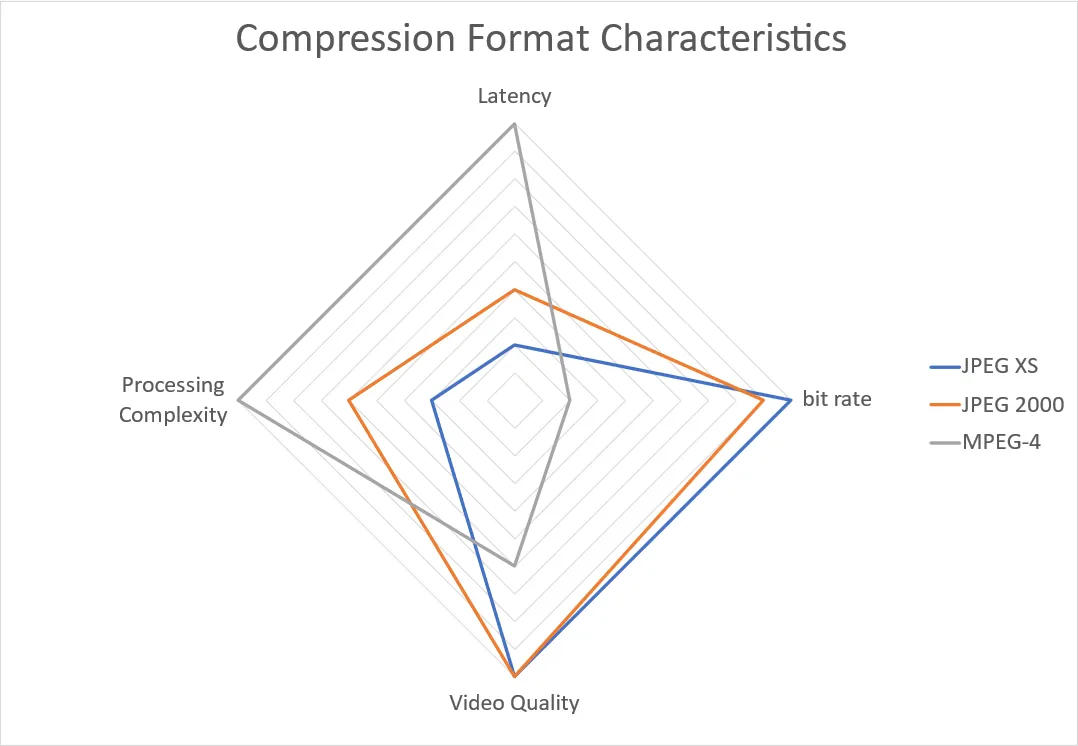
In the comparison here, it is possible to see, for example, that light compression systems such as JPEG 2000 and JPEG XS can achieve significantly better picture quality compared to highly compressed schemes such as MPEG-4.

The Rise of JPEG XS

JPEG XS has quickly gained traction in the live production industry by offering an attractive combination of near-source quality and a favourable compression ratio to deliver very low latency of just a few video lines. Compressed bit rates can be slightly greater than JPEG 2000 (for equivalent picture quality) but in return, JPEG XS can be implemented with much reduced processing complexity than JPEG 2000 requires.

An All-JPEG XS Workflow

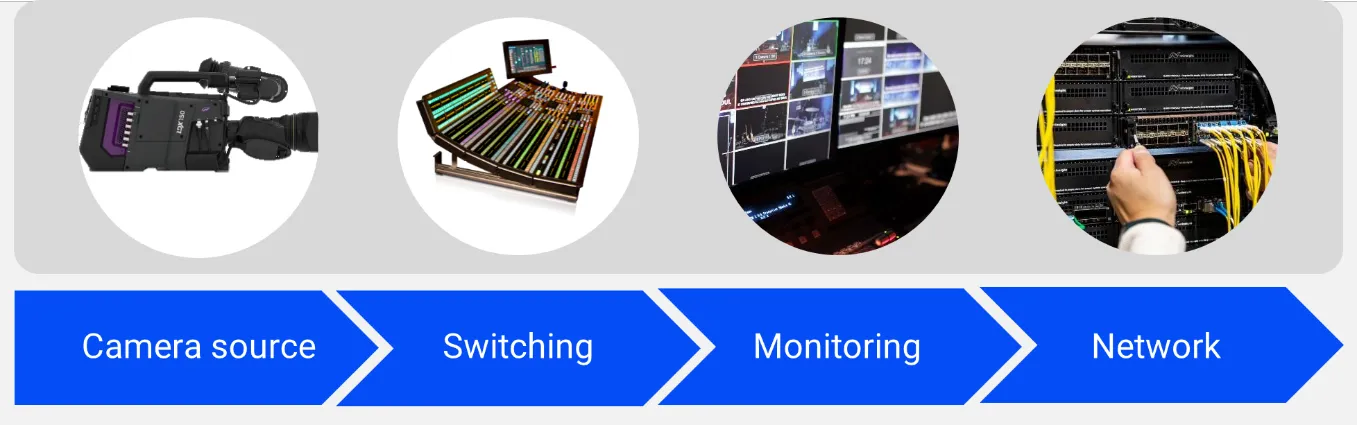
Adopted by key players in the broadcast industry, JPEG XS has become an integral part of broadcast workflows, covering camera, switching, source monitoring, and network transport.

With its broad adoption, JPEG XS can enable live production organizations to accomplish an end-to-end production workflow entirely through JPEG XS streams. 

JPEG XS now integrated into core areas of production

These wide-scale JPEG XS integrations have the potential to optimize connectivity and simplify workflows, allowing creative and compelling visual content through provision for a greater number of IP-native, bandwidth saving JPEG XS streams.

Enabling Diverse Deployments at Scale 

JPEG XS technology is now present across many implementations of broadcast infrastructure, either through physical hardware or in software and in cloud applications. The diversity of implementations allows operations teams to deploy and scale their solutions in all key dimensions. 

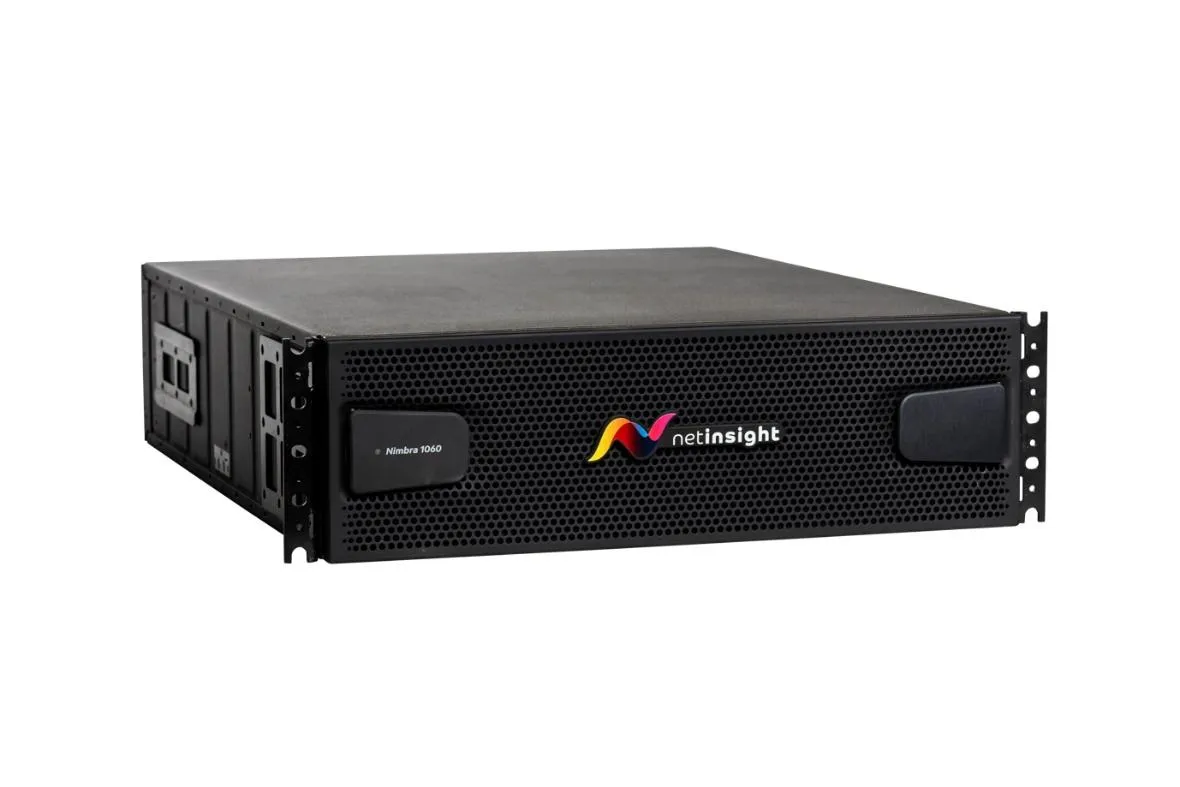
Net Insight has created hardware devices that place low latency, visually lossless and high-density JPEG XS compression as a key component of its core network nodes that can sit at the heart of a media network. 

With a diversity and breadth of deployments from edge, to core, to edge, covering the complete live production workflow, JPEG XS is allowing production teams to offer more creative and compelling visual content by accommodating a greater number of video feeds through flexible connectivity. And with the availability of high channel density networking connectivity solutions, broadcasters can move and share their content with ease across their workflows and across the globe.

Trusted by various global customers across industries

“We can now consider a far wider array of live broadcasting services, often presented at very short notice, for our overseas territories where difficult connectivity environments had, until now, hindered numerous high-quality broadcast opportunities. Net Insight’s solution reduces our operational costs significantly, while at the same time enabling us to maximize our service availability and reach to our overseas territories.”

Pascal Gerard,
French overseas territories, at France Télévisions

“We offered our IP/MPLS media transport solution to the world’s most demanding TV companies, for their contribution feeds and it has performed extremely well. Going forward, we see multiple possibilities to expand our service offering based on the advanced VA platform. In addition, the strong QoS functionalities combined with the advanced monitoring capabilities of the Net Insight Nimbra platform ensures that we can offer the highest quality services to our customers.”

Magdalena Domagalik,
Business Development Manager Media Services, KPN

“For us, carrier grade really means something, and we would never use the Globecast brand on a solution if we didn’t believe it fulfilled our strict quality requirements.”

Benoit Leonble,
Product Manager, International Terrestrial  Solutions at Globecast

Want to know more about us?

Get started today.

GET IN TOUCH

Share this entry
  • Facebook Facebook Share on Facebook
  • X-twitter X-twitter Share on X
  • Whatsapp Whatsapp Share on WhatsApp
  • Pinterest Pinterest Share on Pinterest
  • Linkedin Linkedin Share on LinkedIn

About the Author

David Edwards

Product Manager

David Edwards, Product Manager at Net Insight has over 2 decades of experience in the world of video compression and broadcast transmission. With deep involvement in bringing to market some of the world’s first professional MPEG-4 AVC HD transmission systems and more latterly HEVC HD and 4k solutions.

NEWSLETTER

What’s new at Net Insight

Get the latest news about producing, managing and delivering the future of live sport & events.

  • About us
  • Support
  • Partners
  • Careers
  • Contact us
  • Contact Us

  • White papers
  • Case studies
  • Videos
  • Webinars
  • Data sheets
  • Blogs
  • Events

Sweden

BOX 1200, 171 23 SOLNA

+46 8 685 04 00

info@netinsight.net

United States

Net Insight (Aperi)
770 Paseo Camarillo
Suite 320
Camarillo, California, 93010
USinfo@netinsight.net

Singapore

Net Insight PTE.LTD
81 Ubi Avenue 4, #10-15 UB.ONE
Singapore 408830

+65 6636 2350
Fax: +65 6636 3235

APACinfo@netinsight.net

Net Insight’s Statement on Cookies and Privacy

Copyright © Net Insight 2026

  • Link to LinkedIn
  • Link to Youtube
Link to: How Net Insight’s High-End Distribution Service Seamlessly Integrates with Existing Media Playout Systems Link to: How Net Insight’s High-End Distribution Service Seamlessly Integrates with Existing Media Playout Systems How Net Insight’s High-End Distribution Service Seamlessly Integrates...Link to: What does it mean that Net Insight’s time synchronization technology is getting standardized by ITU? Link to: What does it mean that Net Insight’s time synchronization technology is getting standardized by ITU? What does it mean that Net Insight’s time synchronization technology is getting...
Scroll to top
Book a meeting online or at IBC