BLOG

What’s the latest on Net Insight’s time sync technology becoming standardized by ITU?


ITU has begun the standardization of a new synchronization protocol based on Net Insight technology, something Magnus Danielson (Senior Sync Technologist, Net Insight) commented on in March 2024. We are now checking in with Tahmina Hoque (Technicial Sales Specialist, Net Insight) to hear where we are in the standardization process.


What is this standardization process about?

Back in December of 2023, ITU announced a working item to begin standardization of a new Wide Area Network synchronization protocol. Mobile networks today use either a GNSS signal from the sky to synchronize their networks, or they synchronize through the networks with network-based IEEE 1588 Precision Time Protocol, or PTP. Recent global geopolitical events have highlighted that GNSS is not secure enough to be the single point of synchronization since it’s fairly easy and cheap to jam or spoof the signal. Traditional PTP is a more resilient way to secure synchronization, however it has other challenges. In order to provide the right level of sync precision for 5G, one needs what is called Full Timing Support or ITU-T G.8275.1. This requires hardware support from all the network nodes. If there is leased capacity in the network, meaning someone else’s infrastructure is used, it will not work at all. Given these issues, there was a proposal to create an updated version of PTP. Hence, it got accepted by ITU in December last year, as the “Enhanced Partial Timing Support” aka ePTS as a work item. The process is since ongoing and we’ve now had the first ITU working group meeting, in Montreal in July.


And what was on the agenda for the Montreal ITU working group meeting?

Once a contribution is accepted by ITU, it is assigned to a working group, in this case ITU-T Q13/15, for evaluation and then the long and thorough process of getting it accepted as a standard begins. The working group consists of members representing different companies and they will review the contribution and debate it, while updates are continuously being made to the working document. This process continues for every ITU working group meeting, until the end-result is acceptable, and a finalized document has taken form. For the Montreal meeting, the contribution was going to be reviewed for the first time and, if relevant to the community, get accepted into what ITU refers to as first draft version.

What was Net Insight’s role in Montreal?

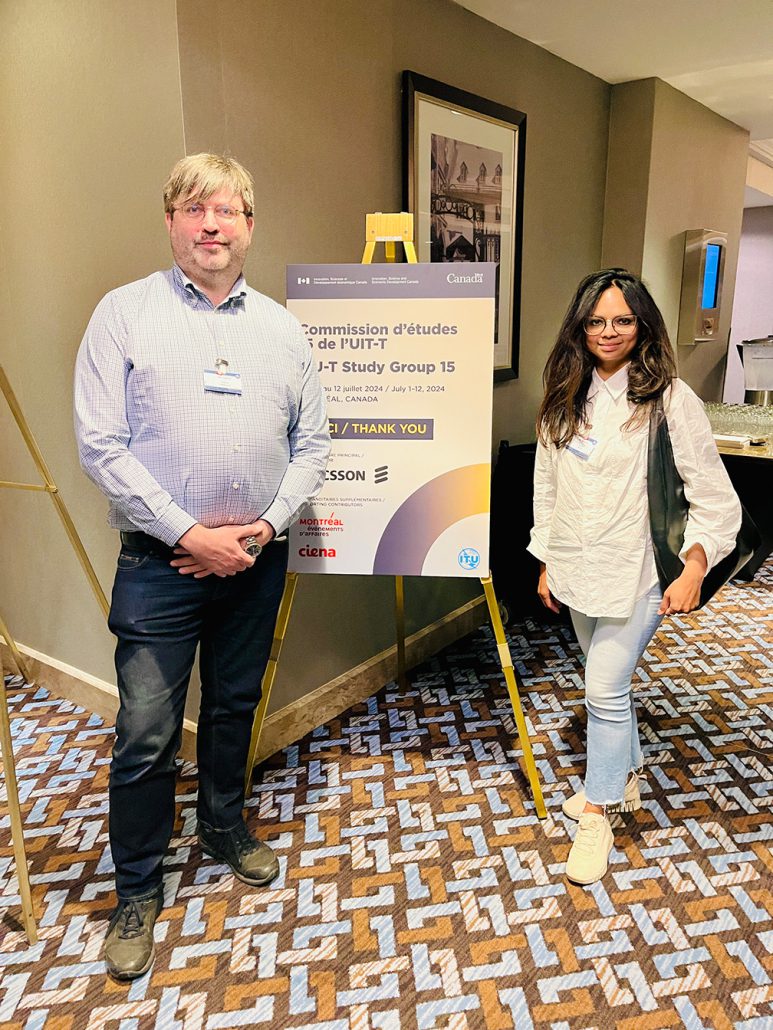
The “Enhanced Partial Timing Support” protocol is based on Net Insight’s technology Precision TimeNet and we are represented in the ITU working Group in order to, like everyone else, drive the contribution forward and get it accepted. I was here together with Magnus Danielson, our Senior Sync Technologist. Magnus is responsible for driving the standardization from Net Insight, and for my part since I’m working in tech sales, I had two additional aspects I wanted to bring in. First, I wanted to make sure to lift customer input in the discussions, since CSPs are not part of the working group. They are though very important stakeholders. The second point for me was to be able to bring back insights from this meeting to our customers. They are interested in how the ITU work is progressing and it is therefore beneficial that I can provide updates on the process, and eventually share in detail what the standard will look like once it’s finalized.

What are your take-aways from the meeting?

Well first, I’m very happy to say the contribution document got approved. The process of defining a standard needs to be very detailed and it’s not certain beforehand if a document can get approved in a single meeting. On that note, I would say my main take-away is that it’s quite impressive to see just how focused and constructive everyone is during these meetings. The participants in these working groups are all experts in their fields and there will be plenty of discussions and debates. However, everyone is always very polite and constructive while twisting and turning different subjects, and these discussions really drove the document forward and enhanced it. What also struck me as very positive is that even though people represent different companies, everyone is viewing the bigger picture and wants to find the best solution for the industry rather than thinking what could benefit a certain stakeholder.

What will happen next in the standardization process?

Having the contribution document approved as a first draft version means it has now become a living ITU document. This will now be reviewed in upcoming ITU meetings, which are scheduled for Hong Kong in November 2024 and then Geneva in March 2025. The ambition there will be to get the document approved one step further. We’re still in quite early days of course, but so far, it’s really exciting to see that we’re on schedule and we maintain the objective for the standard to be fully accepted during 2025.

Want to know more about us?

Get started today.

About the Author

Christoffer Ramm

Christoffer is a marketing and sales executive with 15 years of experience in the global telecoms industry. He is responsible for Strategic Product Marketing for Synchronization at Net Insight, driving the marketing strategy for the company’s network-based synchronization solution for critical networks. Christoffer has 11 years of experience from Ericsson with senior roles within product management, marketing and sales in Europe, Latin America and Africa and has previously also served as Head of Marketing at Swedish telecoms scaleup Subtonomy. He has a Master of Science in Electrical Engineering from the Royal Institute of Technology in Stockholm and an MBA from Henley Business School in Copenhagen.